



What Are Souls?
Last Updated September 1, 2026

The Soul, Self or Atman
Spirit Versus Soul
The term spirit has often been used interchangeably with soul. Let’s unpack this. When we mention spirit, we’re referring to the divine light of Brahman (Bhagavad Gita, 7:24) — the spiritual essence and divine spark that pervades every living thing in existence, as suggested by Swami Mukundananda (Bhakti Yog Saint & Yoga Teacher). It’s considered the life force and impelling influence of Source (Edgar Cayce Reading, 5749-3). The divine light of Brahman is said to emanate from Bhagavan, which is considered Source’s divine personal form.
Divine light is essentially infinity, pure consciousness, and unmanifested potential. But, once focused through willpower (intelligent infinity) it can become the individualized spiritual vessels known as souls (Bhagavad Gita, 7:5). This suggests that all souls originate from Bhagavan in the spiritual universe (Bhagavad Gita: 13:22-32, 13:32-33) as stepped down, individualized aspects of the divine light of Brahman.
According to Vedic teachings, the soul is referred to as the immortal self or atman. The atman is considered pure existence, the observer, and source of individual consciousness. Because the soul is considered a fragment of Source, its nature is also sat-chit-ananda or eternality-consciousness-bliss, as suggested in the Bhagavad Gita (4:5). But, when residing in the hearts of all living entities, the soul is expressed, conditioned, and spread as individualized consciousness.
Ergo, the soul radiates consciousness, spreading it throughout the material body (Bhagavad Gita, 13:34). So when the soul leaves the body, consciousness stops spreading and the material body is declared dead. So perhaps the soul can be seen as the bridge between spirit and matter.
Think of it this way fellow souls. The soul is like a light bulb, individual consciousness is the light that spreads from the bulb, and the divine spark is the electricity that powers the light bulb. The light (individual consciousness) is the symptom that proves the bulb (soul) is present and functioning in a room (the body). But, the light isn’t the bulb itself. The bulb is a vessel for and source of that specific, localized light.
The “Fall” of Man
Edgar Cayce (Clairvoyant & Healer, 1877-1945) refers to the soul as an individual expression of the spirit — the individual that grows to be one with, or separate from, the whole (Reading, 5749-3). This suggests that souls can choose to experience the material universe to exert their free will and spiritually evolve. This is consistent with Gnostic teachings which explain that Sophia (divine feminine) chose to descend into the densities of matter to help awaken those ignorant of their origins. This viewpoint is radically different from those who view descending to the material universe as some form of punishment or the “fall” of man, which is how the story of Adam and Even in The Bible (Genesis: 3:14-24) is often interpreted.
Whether souls are physically descending or projecting themselves into the material universe is debatable. But, here’s the kicker fellow souls. When we make the decision to descend to the material universe, we run the risk of forgetting our divine origins, falling under the illusion of maya. Swami Mukundananda (Bhakti Yog Saint & Yoga Teacher) explains this concept further stating that the ego can make souls identify with the body so they attribute the actions of the body to themselves.
As BK Shivani (Spiritual Teacher) explains, ego is our attachment to a wrong image of ourselves. It makes us think we’re doing this or that (Bhagavad Gita: 15:9, 13:22, 13:30). But the liberated soul recognizes that actions are only performed by the body and experienced by the mind, and that we are simply witnessing and permitting those actions to take place.
What’s also interesting is that, in spite of all of this, the soul doesn’t get tainted by the actions of the material body and experiences of the mind (Bhagavad Gita, 13:33). Is this similar to how Source is able to be the creator and sustainer of everything while not being tainted or influenced by maya? And how does this relate to our higher selves?
Higher Versus Lower Selves
Two Aspects of the Same Coin
What is the concept of the higher self? The higher and lower selves can be explained many different ways. For example, Sri Ramana Maharshi (Sage & Jivanmukta, 1879 – 1950) explains that the higher self is that where there is absolutely no “I” thought or ego, which is called silence.
According to Vedanta, the atman is considered inherently eternal and pure, but until it sheds its ignorance, it remains in a state of delusion. Ergo, the higher self could be considered the unmanifested, liberated state or aspect of the atman — our divinity or divine spark. While the lower self could be considered the manifested, temporary state or aspect of the atman bound by maya, ego, and karma — our humanity or ego.
Could the higher self also be considered the knower of its field (kshetrajña) that holds accumulated wisdom, contains the memories of past lives, and guides the lower self to liberation as a witness? This would make the lower self the field of activities (kshetra), which is considered the doer who is subject to desires, attachments, and aversions (Bhagavad Gita, 13:2).
According to the Law of One (70:8), higher selves are considered our future selves from mid-level 6 consciousness while lower selves are considered our incarnated selves experiencing the material universe as mind/body/spirit complexes. It further explains that our higher selves are beyond polarity and linear space/time, existing simultaneously at all consciousness levels. They possess the total picture of all of the soul’s past life experiences and the wisdom gained throughout incarnations (36:1-15. 37:6). Perhaps in this context, the higher selves are more synonymous with the spirit aspect of the mind/body/spirit complex.
Yes, all of these different explanations can be confusing — mainly because the intellect wants to view the higher and lower selves as two separate entities. What resonates with us is perceiving the higher and lower selves as two aspects or states of the same soul. Ergo, soul = higher (divinity) + lower (humanity) selves.
Purpose of Higher and Lower Selves
Despite the different interpretations of what they are, the purpose of higher and lower selves seems to be consistent throughout our research. Higher selves are considered a resource for introspection, healing, growth, guidance, and probable outcomes for lower selves. They can help create the script for life plans and design catalysts (challenges, relationships, or opportunities) to help us reach our ascension goals. They can also reach back into linear space/time to serve as our internal intuition or inner voice that guides us through lessons. Yet, they’re said to not impose decisions on our lower selves because they respect the ever-changing nature of free will.
Lower selves are like the costumes that souls wear or vehicles they drive to experience the material universe. As the manifested self, the lower self acts as a sensor to receive catalysts. They can also be thought of as mirrors for higher selves to understand their true nature.
How do we distinguish between the higher and lower selves? The higher self tends to express itself with love, calm, compassion, clarity, and inner coherence. While the lower self tends to express itself with urgency, fear, attachment, and external validation. Think of it this way. Where the lower self will tell us we are victims of circumstance, the higher self will tell us to take accountability to create a different reality. When the lower self tells us we live in scarcity, the higher self will tell us there is always enough. While the lower self will see mistakes, the higher self will see lessons. And while the lower self will complain about everything, the higher self will be grateful and find joy in every moment.
While some would suggest we destroy, transcend, or inactivate the lower self, what if there’s another option? What if we transcend the limitations of the lower self to make it so purified and transparent that the divine light of Brahman can shine through it without being distorted by murky, egoistic blockages. This would enable the lower and higher selves to unify into a conscious, harmonious soul that retains its material universe experiences (humanity) while embracing its divinity.
And from there, to infinity and beyond!
Descension Versus Projection
Souls As Descendants
How exactly does spirit or soul vessels traverse the material universe? Well, there are varying schools of thought. Perhaps souls physically descend from the spiritual universe down to the material universe. Or perhaps they project an aspect of themselves into the material universe. Let’s dive into these concepts. When we mention soul descension, it’s in the context of souls stepping down from the spiritual universe. This has often been interpreted as the “fall” of man, fall from grace, or repercussions of Adam and Eve eating from the tree of knowledge of good and evil (The Bible: Genesis, 2-16). In this context, descension is seen as more of a punishment. Is there another way to view descension?
Swami Mukundananda (Bhakti Yog Saint & Yoga Teacher) often uses the term descension to describe when Source uses avatars or forms to venture into the material universe. He explains that divine descension often occurs when unrighteousness prevails and dharma needs to be reestablished (Bhagavad Gita, 4:7). In this context, descension is seen as more of a righteous duty or honor.
Souls As Projectors
When we mention projecting it’s in the context of our reality being a hologram. Think of it this way fellow souls. What if the unmanifested soul can’t perceive itself in the void of infinity, just as we can’t see ourselves without a mirror? Perhaps it uses a hologram, where the lower self is the manifested image within that hologram. This way, both the higher and lower selves can exist at the same time. Through its lower self, the higher self can watch its own holographic image — reactions, mistakes, and triumphs — to understand its own nature. Afterall, what better way for us to understand what we are, than by understanding what we aren’t.
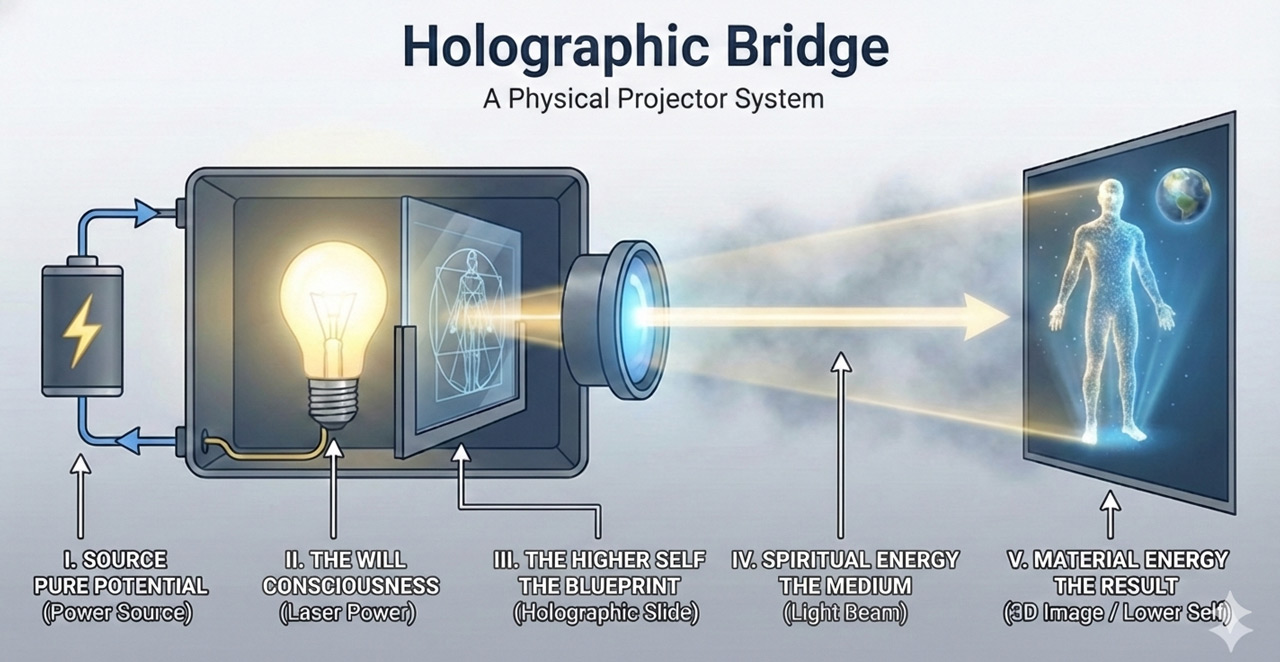
Let’s expand on the hologram analogy. Imagine our entire reality is generated in a metaphysical movie theater (infinity). Source (intelligent infinity) is the power for the entire theater. Each soul (actor) is its own unique movie projector. Source also serves as infinite light bulbs, providing infinite power (consciousness) for each projector. Each higher self is like a high-tech film slide inside each projector that holds the life plan blueprint (script) for the soul’s incarnation (movie role). When the power from a light bulb shines through a slide and out of the projector lens as spiritual energy, it projects a lower self (3D holographic character) onto the movie screen. The movie screen provides the surface for the holographic spiritual energy to hit. It represents the plane of existence in the material universe where the projection becomes visible, making the lower self look solid and real.
Even though the lower self thinks the movie screen (material universe) is solid and real, it’s actually just an outward manifestation of the soul’s information tucked away inside the higher self. As the consciousness of the lower self moves through the movie screen, every choice it makes is beamed back to the projector. It’s like the higher self is using the movie production to test whether a specific set of catalysts will help the lower self learn lessons — lessons like choosing love over fear. Ergo, if the lower self reacts with fear, the life plan blueprint (script) remains the same, and the projector will keep playing similar scenes (catalysts) on the screen until the lesson is learned. If the lower self responds with love, the higher self updates the life plan blueprint.
The gist is that the soul evolves by changing the life plan blueprint in the projector based on the performance on the movie screen. The goal is that eventually the 3D holographic character (lower self) on the screen becomes so aware and clear on the screen that it remembers it’s actually the actor (higher self) simply playing a character. Once this level of awareness is reached, it creates a high-definition, luminous hologram rather than a dim, flickering one. Ergo, the lower and higher selves can unify into one fully conscious, harmonious soul.
Reality As a Hologram Summarized
STAGE
THE WHO/WHAT
THE HOW (HOLOGRAM)
ENERGY
FUNCTION IN REALITY
The Source
Infinity (Parama Brahman, The Godhead)
Pure Potential
Unity (Silence, Non-Duality, Stillness)
The silence before the first distortion
The Will
Intelligent Infinity (The Father, Bhagavan, One Infinite Creator)
The Laser Power
Potential Energy
The awareness that wills the projection to begin
The Design
The Logoi (The Son,
Higher Self, Resolute Intellect)
The Holographic Slide
Geometric Blueprint
The information that shapes the light into an entity
The Material
Para Prakriti (Love/Light)
The Light Beam
Kinetic Energy
The Result
Apara Prakriti (Light/Love, The Lower Self, Matter)
3D Image
Crystallized / Solid
Reality as a Hologram Illustrated