





What Happens When We Die?
Death Can Happen in Awareness
The Bhagavad Gita (2:13) explains that creation, maintenance, and destruction are a repetitive cycle. Our resources, including Unlocking the Soul, agree that death is part of this cycle. Shedding our material bodies enables us to transition from one life, consciousness level, and plane of existence to the next. Some even suggest there are no accidents when it comes to death, like in the movie Final Destination. This would suggest that our souls (higher selves) plan aspects of our deaths – sometimes just days before our exit.
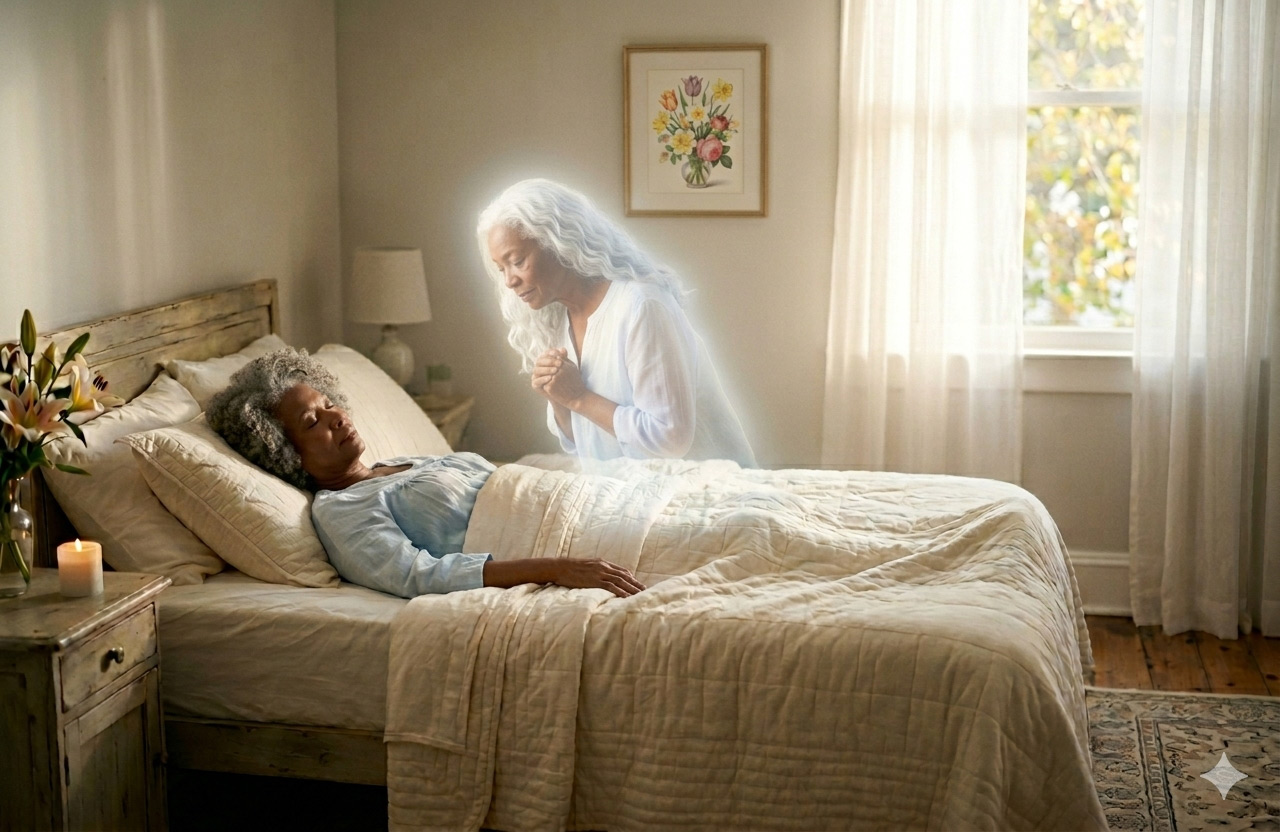
With enough awareness during an incarnation can we (lower selves) influence and become aware of our exit plan before it happens? Both the Bhagavad Gita (8:5-7, 13) and Sadhguru (Guru, Yogi & Mystic) explain that if we maintain a certain level of awareness throughout our lives, gross physical body exit can happen in awareness and with grace – preferably without excessive medical attention and away from loved ones whose grief and attachments could bind us to the current life. This brings us to an interesting question. How do diseases factor in to our exits? Diseases can act as catalysts to end an incarnation when there’s a lack of spiritual growth, according to the Law of One (83:5-6).
The Bhagavad Gita (8:13) also mentions that those who depart the body remembering Source and chanting the syllable Aum will attain the supreme goal. This is inline with the concept that what matters most at the time of death is our total vibrational frequency (recorded by the crown energy center), which we construct through the way we live.
With enough awareness, perhaps death could even occur at will through the mastery of the seven energy centers (chakras), like with Sadhguru Sri Brahma at Seventh Hill. Could this be similar to mahasamadhi? Mahasamadhi is a Sanskrit term referring to a spiritual state where a liberated entity, consciously and willingly, departs their gross physical body while in the deepest meditative state of nirbikalpa samadhi. By willfully shedding the gross physical body while fully liberated, the entity is said to extinguish all remaining karma and break the cycle of rebirth, allowing them to achieve moksha (harmony with Source). This is different from the ordinary, unconscious process of death.
Some would suggest mahasamadhi is nothing more than glorified suicide. Sadhguru explains that mahasamadhi isn’t suicide, since it’s not driven by a desire to escape suffering. It simply means a great equanimous intellect. Ergo, it’s a deliberate act of transcending the limitations of the material form, achieved through profound spiritual realization and equanimity. Paramahansa Yogananda (Monk, Yogi & Guru, 1893 – 1952) and Sri Ramana Maharshi (Sage, 1879 – 1950) are said to be examples of those who’ve attained mahasamadhi.
The Process of Dying
Discarding the Physical
According to Autobiography of a Yogi, physical death or exit from the gross physical body consists of the disappearance of breath and the disintegration of fleshly cells, with an entity losing its consciousness of flesh and becoming aware of its subtle astral body (43:359). This is inline with the Bhagavad Gita which explains that at the time of gross physical death, the soul discards its gross physical body, keeping the subtle astral and causal bodies (2:13-30, 15:8). This prevents the soul from joining Source in eternal harmony (moksha), as explained in Autobiography of a Yogi (43:362).
When we typically shed our gross physical bodies, it’s said that unliberated souls exit through the lower energy centers, leaving our gross physical bodies as discarded shells. This is consistent with the Law of One (47:11) which explains that while entities are dying here on Earth, parts of our subtle energy system gradually activate and deactivate. The concept of energy influxes isn’t too far-fetched given the mainstream scientific community has already proven that a surge of electricity enters the brain moments before death.
As our energy system is going through influxes, our gross physical bodies will decompose to merge back into material energy, as explained by the Bhagavad Gita (13:31). The Law of One (30:3-4) explains that there may be some trauma or loss to the mind. However, our research suggests that souls and consciousness will shed their gross physical bodies before they start to decompose, which is similar to what many NDE’s describe. Regardless, our subtle astral and causal bodies are said to remain intact after death, just with some energy system components being deactivated or in potential (Law of One, 30:3-4).
The Process of Dying Can Take Days
Various resources, including Sadhguru (Guru, Yogi, & Mystic), explain that the process of dying can take days or even weeks as consciousness and certain material energies leave our energy systems at varying times. This is consistent with the Tibetan Book of the Dead or Bardo Thodol (7) which explains that the duration of the state where consciousness has fainted away is uncertain as it depends on the state of the nerves and vital-force.
Consider this fellow souls. Some even suggest that the process of shedding our bodies starts from the moment we materialize in a plane of existence, meaning our gross physical bodies are gradually decomposing starting from conception. The mainstream scientific community does confirm that our bodies are constantly undergoing renewal, meaning many cells and tissues (e.g. skin cells) replace themselves rapidly while some (e.g. eye lens) are never replaced.
It’s also suggested that as we start the process of physical death, it becomes easier for us to penetrate the semi-permeable veil of amnesia. If one resonates with the concept that everything is energy, then deactivation, decomposition, and dematerialization would be consistent with the first law of thermodynamics which states that energy can neither be created nor destroyed – only converted from one form to another.
Understandably, not as much is known about exiting the subtle astral and causal bodies. According to Autobiography of a Yogi, souls inhabiting their light-based, subtle astral bodies don’t contend with painful death (43:359-360). What’s more, subtle astral plane death seems to mainly consist of the disbursement of prana (life force energy). For those inhabiting their causal entities, both death is said to be done through thought.
Death Rituals
Taking Care of the Dead
Sadhguru (Yogi, Guru & Mystic) stresses the importance of death rituals, explaining several things that can be done to take care of the dead. One includes tying up their big toes. Another is cremating their bodies within 4 hours of death so that life force energy can’t return. The Tibetan Book of the Dead also offers specific resolutions that should be spoken to deceased entities to guide their consciousness through the intermediate state (bardo) between death and rebirth. In terms of practices, it suggests that animals should not be slain on account of the deceased nor should relatives weep near the deceased (51).
Like the Tibetan Book of the Dead, BK Shivani (Spiritual Teacher) also stresses the importance of bidding the dead well on their journeys and sending them positive, loving thoughts. She explains that excessive grief can create unhealthy attachments for the deceased, anchoring them to their gross physical bodies. This makes it difficult for them to transition to the astral plane of existence, as explained in Autobiography of a Yogi (27:219-220) when Paramahansa Yogananda’s (Monk, Yogi & Guru, 1893 – 1952) attachment to a deer delayed its transition.
Resurrecting the Dead
So does this mean it’s possible to bring someone back from the dead? Instances of resurrection were described by Paramahansa Yogananda when he spoke of his friend Rama being resurrected from the dead and his guru Sri Yukteswar visiting him after death (Autobiography of a Yogi, 32:253-256). What’s more, both Jesus (Luke, 23:52-24:40) and Lazarus (John, 11:1-44) were described as being resurrected in The Bible. Although, there is scholarly support to suggest that Jesus actually survived the crucifixion and returned to India rather than dying and being resurrected. This is referred to as the swoon hypothesis.
This raises an interesting question fellow souls. What if we need to reconsider our definition of resurrection? Perhaps resurrection could be seen as more symbolic, simply meaning a transition, awakening, or inner transformation — like transitioning to different bodies or shedding ego identities. Ergo, it would not be an event to be observed, but a state one enters.
On the other hand, perhaps resurrection could equate to instances where people were declared medically dead but were still alive. For example, certain aspects of their energy systems and bodily functions could have slowed down to the point that they appeared dead for a short period of time. This death-like state could happen for a variety of reasons, including mastery of pranayama (breath control), but in the mainstream scientific community it’s often referred to as the Lazarus syndrome or apparent death.
Suspended animation of internal organs is also said to be possible during deep states of meditation such as super-consciousness (Autobiography of a Yogi: 13:123, 26:209) and through the use of certain drugs. Our research even suggests that some entities who were crucified occasionally survived with the proper medical care. This gives further credence to the swoon hypothesis given the mired of processes that Jesus was said to endure after crucifixion — being wrapped in healing substances and placed in an above ground tomb more conducive to recovery rather than being burying.
So based on mainstream science, perhaps Jesus’s crucifixion death could be referred to as some form of reversable clinical death (cardiac arrest) rather than irreversible biological death (brain death). But we digress…
Fellow souls, perhaps it’s time to think of resurrection in terms of awakening Christ Consciousness within rather than reanimating the gross physical body. Regardless, our research suggests that death, shedding the body, or transitioning should not be feared. It’s an inevitable part of our spiritual journeys. Some Latin cultures even celebrate and honor death, such as with the Day of the Dead (Dia de Meurtos) which is typically celebrated November 1-2. Ram Dass’s astral teacher Emmanuel provided one of our favorite death analogies: death is like taking off a tight shoe.