






What Is Maya, the Veil, and the Three Gunas?
Last Updated August 29, 2026
Material Nature
The Three Gunas
In the context of the material universe, maya is the power of apara prakriti (material energy, matter) and mahamaya. It’s used to veil the true nature of reality. Essentially, maya conditions unliberated souls to perceive apara prakriti as real and permanent. It’s often thought of in the context of the relationship between matter (sat) and consciousness (chit). According to the Bhagavad Gita (14:5-15), there are three gunas that represent the nature of apara prakriti. The three gunas (forces, states, or modes) of material nature are sattva, rajas, and tamas. They bind the unliberated soul to the mind and body, influencing our personality and character.
The gunas can also act as spiritual guideposts. Awareness of the gunas can indicate where we are and where we want to be — whether we’re moving towards Source (sattva), running in place (rajas), or turning away from Source (tamas). It’s thought that every conscious entity possesses a combination of all three gunas, but one guna tends to dominate at any given moment, according to the Bhagavad Gita (14:10).
Guna Characteristics
Each guna has distinct characteristics (Bhagavad Gita, 18:19-28):
- Sattva is the nature of goodness, balance, clarity, unselfish joy, and inspiration — unveiling what’s true and real. While sattva promotes life, energy, health, contentment, knowledge (knowledge that unites and not divides), and purified intellect, it’s still within the realm of maya so we shouldn’t get too attached to it. It’s thought that a vegan or vegetarian diet cultivates sattvic qualities. Swami Mukundananda (Bhakti Yog Saint & Yoga Teacher) suggests that humans are herbivores by nature based on our teeth (Bhagavad Gita, 17:8-10).
- Rajas is the nature of passion, desires, and pain — coupling our senses with material objects. It creates attachments to the fruits of our actions and sensory pleasures. Rajasic foods tend to be very bitter, sour, salty, hot, pungent, or dry, according to Swami Mukundananda (Bhagavad Gita, 17:9).
- Tamas is the nature of ignorance — concealing the presence of consciousness. It creates attachments to laziness, procrastination, delusion, sleep, and negligence. Foods that are overcooked, stale, putrid, and impure are thought to be tamasic. Swami Mukundananda suggests not eating cooked foods that are more than three hours old (Bhagavad Gita, 17:10).
The Bhagavad Gita (14:20-26) also explains that the goal for unliberated souls is to transcend these forces. Yes, transcend, rather than conquer or defeat. Since maya is considered one of Source’s cosmic energies, there is no defeating maya, as suggested by the Bhagavad Gita (7:14) — only surrendering to Source so that Source can release us from maya’s clutches. Once transcended, souls become liberated (free from birth, death, old age, misery) and access the consciousness level of Brahman. They remain equipoised and no longer disturbed by worldly situations, as they comprehend that everything is a manifestation of Source’s energy.
Maya as the Ultimate Spiritual Catalyst
Veil of Amnesia or Forgetting
For many of us in the material universe, it’s thought that we have a temporary veil of forgetting (Law of One, 21:9) or veil of amnesia where we don’t remember our unified divinity. Is the veil of forgetting why we don’t remember our past lives? According to the Bhagavad Gita (7:13-14), the veil can be attributed to the illusionary nature of maya, which is generally classified as yogmaya and mahamaya. In the spiritual universe, yogmaya veils the magnificence of Source so that souls can form a personal relationship with Source. In the material universe, mahamaya keeps unliberated souls in ignorance and veils us from recognizing our true spiritual nature.
Why are we subject to this illusion? Gnostic teachings (The Apocryphon of John) suggest that this illusion is a result of the divine entity Sophia descending from the unity of Pleroma (spiritual universe or heaven) to give birth to Yaltabaoth (the Demiurgos, Satan) — the false creator of the material universe. While Yaltabaoth possesses Sophia’s divine spark of remembering, he is ignorant of his true spiritual nature. His duality is mirrored in the creation of the material universe, hence the veil.
There are interpretations of Sophia’s story that view the veil as more of a punishment for her giving birth without consent or a male counterpart. Themes of disobedience and punishment are also consistent with Adam and Eve’s story in The Bible (Genesis, 3:14-17). But we resonate with the veil simply being a consequence of free will. Perhaps the heart of Sophia’s story is awakening — since we are forever illuminated by Sophia’s divine spark, we never fully forget what we truly are. Meaning, the capacity for awakening is always within us.
Veil as Motivation
What purpose does the veil serve? The Law of One (54:24, 82:22) suggests that we would not have the motivation to work, learn, ascend spiritually, or maintain a state of devotion if we were already in a state of total security and oneness with all. This is essentially what happened before the veil of amnesia was implemented, when entities were referred to as mind/body/spirits instead of mind/body/spirit complexes (Law of One, 87:18).
Having a veil of amnesia does seem to be effective at giving us the motivation, kick in the pants, and reward system we need to seek realized knowledge, remember our unified divinity, and ascend spiritually. After all, the point is to see the material universe clearly, not remain complacent in its illusion, right? It’s through Source’s grace and the tenacity to complete our prescribed worldly duties and spiritual practices (Bhagavad Gita: 2:47, 6:33, 8:7) that we can transcend maya to achieve moksha or permanent harmony with Source.
Seven Rays and Archetypal Mind
Is there a correlation between maya, the three gunas, and the archetypal mind? Our research suggests that there are universal patterns of human behavior. Carl Gustav Jung (Psychologist, 1875 – 1961) described these as archetypes. Jung explained that each of us carries one or a combination of these archetypes which influences our strengths, personality, life challenges, and so forth. They serve as general blueprints, qualities, or ideals for our individual nature. Each archetype is said to have its strengths, but also its shadow side which is why balance is key.
Jung mentioned four main archetypes which are the self (total psyche), shadow (psyche’s dark aspects), persona (mask concealing inner self from outside world), and anima/animus (feminine/masculine parts of psyche). They can overlap or combine to create these 12 collective unconscious archetype figures or images including:
- Innocent – Walks through life with an open heart. They must learn that real happiness comes from within.
- Everyperson/Orphan – Knows what it’s like to feel alone and finds comfort in relationships. They must learn that true belonging starts with accepting themselves.
- Hero/Warrior – Refuses to back down from a challenge. They must learn that strength also means knowing when to let go.
- Caregiver – Pours their heart into others. They must learn that they also deserve care.
- Explorer – Always looks for what lies beyond the horizon. The must learn that no journey outside of themselves will ever replace the one within.
- Rebel – Refuses to follow the rules and challenges the status quo. They must learn that the real power lies in not only tearing something down, but building something better in its place.
- Lover – Lives for connection, love, and passion. They must learn that true love isn’t about completing someone but standing strong beside them, whole and unshaken.
- Creator/Artist – Sees what doesn’t exist and brings it into fruition. They must learn to let go of perfection and to create despite flaws.
- Jester/Comedian – Views the absurdity of life with humor. The must learn that true joy isn’t about escaping suffering but embracing life fully, both the good and bad.
- Sage/Philosopher – Always searching for knowledge. They must learn that knowledge must be experienced, not just intellectually understood and once that happens it becomes wisdom.
- Wizard/Magician – They see what others can’t, understanding the hidden forces of life. They must learn that true magic doesn’t control others, but awakens them.
- Rulers/Leader – Craves stability, order, and control. They must learn that true leadership isn’t about power but about lifting others up.
These archetypes are consistent with the seven rays which are defined as energy forces (life impulses, types, or traits) that underlie and create all forms of life and matter in the material universe. The seven rays are:
- Freedom – the Ruler
- Unity – the Philanthropist
- Comprehension – the Philosopher
- Harmony – the Magician/Artist
- Truth – the Scientist
- Goodness – the Devotee
- Beauty – the Craftsman
The Bhagavad Gita (4:13, 18:42-44) mentions similar classifications based on maya and the nature of the three gunas. It explains four categories of occupations: philosophers, devotees, and teachers (sattva); warriors and leaders (sattva and rajas); merchants and farmers (rajas and tamas); and laborers or working-class (tamas).
The Law of One (67:28, 90:14) explains that logoi design the archetypal mind which contains all aspects which could affect the mind and inform all experiences. It further explains that trying to condense archetypes is erroneous. But, it does mention seven classifications with 22 archetypes (88:24). The seven classifications are:
- Matrix – passive self
- Potentiator – power available to self
- Catalyst – lesson arriving for self
- Experience – learning done by self
- Significator – meaning found by self
- Transformation – evolution of self
- Great Way – universe of residence as perceived by self
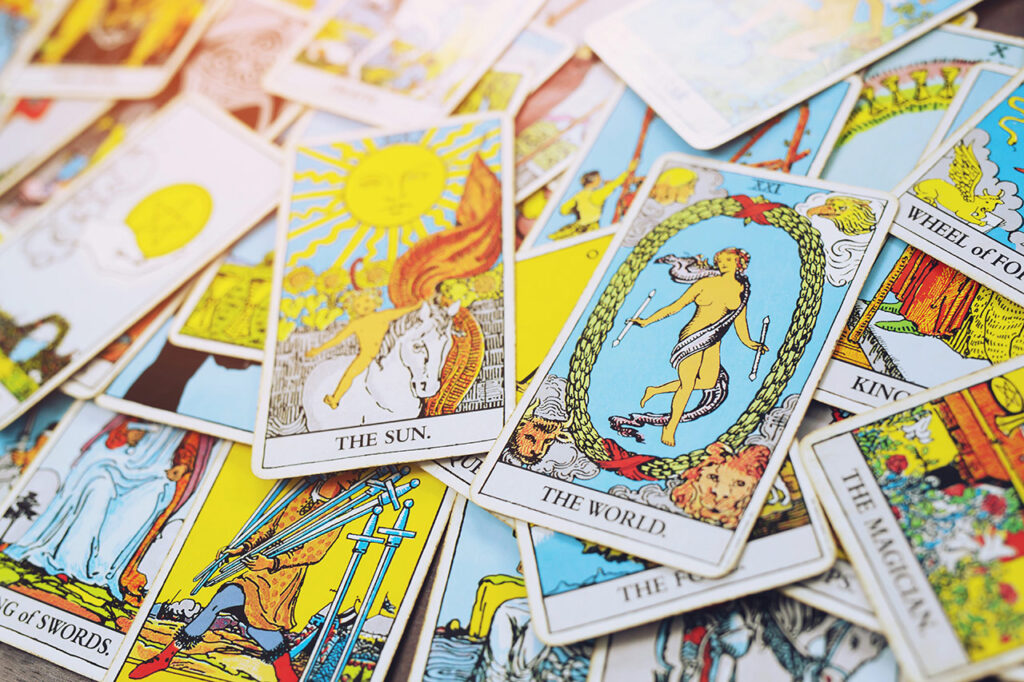
We won’t delve further into these classifications, but they do appear to share some similarities with tarot. Like the gunas, the seven rays are thought to be present in everyone at the same time, although not all of them influence us at the same time. One typically dominates, determining our primary motives and decisions. Each ray is also associated with or dominated by at least one of the seven principles (The Seven Rays: C9:32) mentioned by Ernest Wood (Yogi, Sanskrit Scholar, and Theosophist, 1883-1965). These seven principles are:
- Natural Laws – associated with Lord Brahma or material energy
- Natural Energy – associated with Lord Brahma or material energy
- Matter – sat, associated with Lord Brahma or material energy
- Will – ichchha, awareness of self, associated with Lord Vishnu or consciousness
- Wisdom – love, jnana, awareness of others, associated with Lord Vishnu or consciousness
- Activity – thought, kriya, chit, awareness of things, associated with Lord Vishnu or consciousness
- Maya – ananda, unveiling true reality, associated with Lord Shiva
The Seven Rays correlate the three aspects of material nature with the three gunas: natural laws as sattva, natural energy as rajas, and matter as tamas (The Seven Rays: C6:21). The gist of all of this fellow souls, is that it is from these types of blueprints and principles that the natural laws and complex systems that govern the material universe are developed.