



What Is Reincarnation?
June 20, 2026 | Updated September 28, 2026 | By Soul on a Journey | 6 Min Read
What Does Reincarnation Mean?
Cycle of Life and Death (Rebirth)
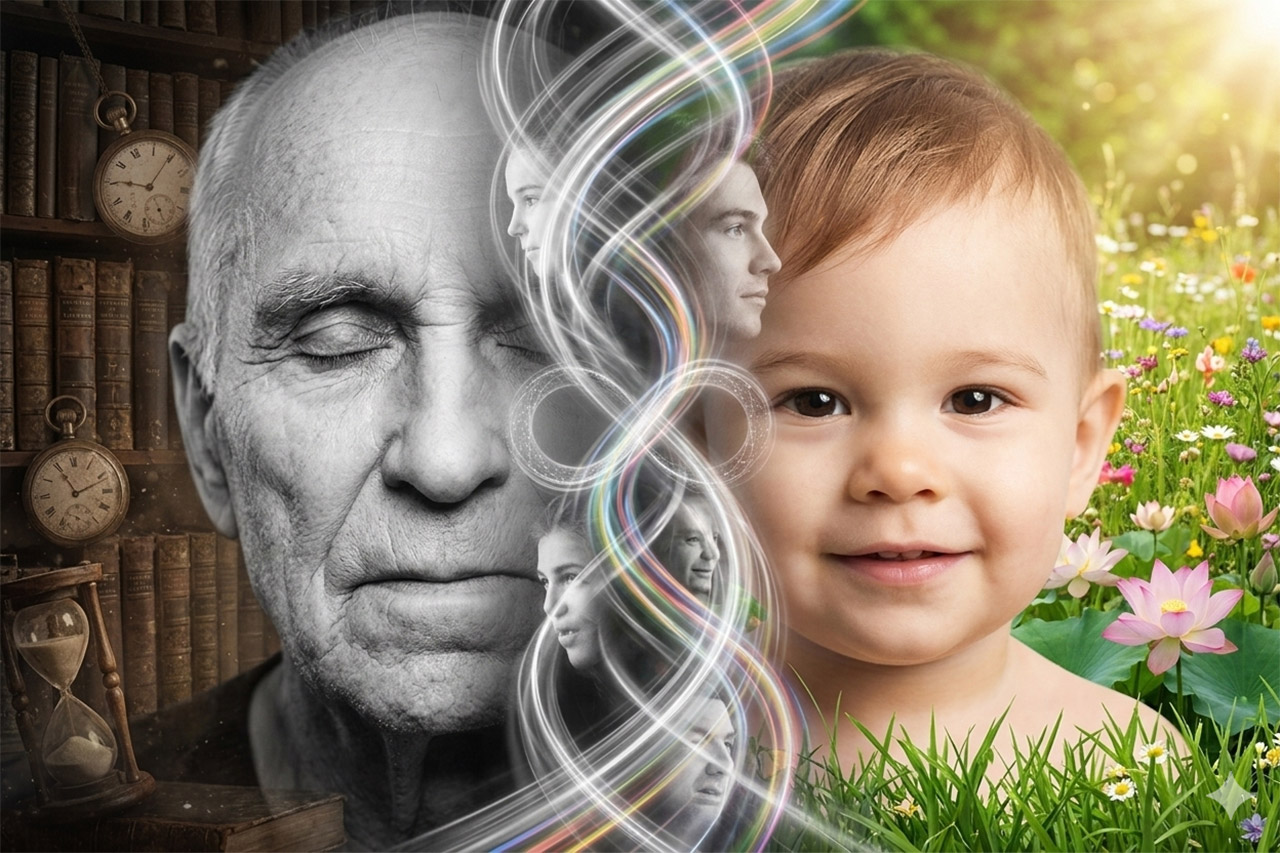
What does reincarnation really mean? According to Edgar Cayce (Clairvoyant & Healer, 1877-1945), reincarnation is the concept that each of us – specifically unliberated souls still bound by karma – goes through a series of lifetimes for soul growth and consciousness evolution. What is the purpose of reincarnation? Edgar further explained that each life is necessary for the soul’s development and the purification and perfection of will (Readings: 2072-4, 5749-14). We think of reincarnation as a process that allows us to progress from lower states of consciousness to higher — refining our awareness to eventually realize our true nature and return to harmony with Source.
While reincarnation is often met with extreme skepticism from the mainstream scientific community, several philosophies and religions accept the concept of reincarnation. For example, Buddhist teachings associate it with the concept of the samsara cycle of life and death (rebirth). Essentially, the fuel for the samsara cycle is karma. Karma is considered our actions and their resulting consequences. It’s also considered the mechanism we use to refine our awareness. Once we resolve all outstanding karma, then we can be released from all forms of suffering (dukkha) and the cycle of rebirth. This is referred to as nirvana in Buddhist teachings — the unconditioned state of liberation.
Does Christianity Support Reincarnation?
It’s thought that early Christianity did at one point support the idea of reincarnation. Even The Bible seems to elude to it vaguely when it explains the life of John the Baptist who was Elijah reincarnated (Matthew: 11:13-14, 17:10-13). But, around 553 AD or so, reincarnation was declared as heresy (Bhagavad Gita: 2:13 & Autobiography of a Yogi: 16:151). Or at least, explicit reference to reincarnation (rather than symbolic) seemed to be frowned upon. Perhaps somewhere along the line, the Church decided it would be best to promote the idea that we only have one life to live.
But, there’s a slight problem with that rationale. Swami Mukundananda (Bhakti Yog Saint & Yoga Teacher) explains that without the concept of rebirth, it’s difficult to make sense out of the suffering, chaos, and incompleteness in the world. We struggled with this at a young age, not understanding why bad things happen to good people and why good things happen to bad people. Specifically, we couldn’t understand why some babies are born with debilitating diseases, born blind (Bhagavad Gita, 2:22), or born with unexplained fears while others are born perfectly healthy.
Unfortunately, The Bible, as it was taught to us, never really answered these types of questions. Although, we can’t put the blame solely on The Bible. As we now understand hold-heartedly, our lack of awareness to correctly interpret The Bible and our lack of willpower to ascertain the truth also played a part in why we weren’t able to see The Bible for what it really is. Nevertheless, being exposed to the concept of reincarnation though other resources, like Swami, finally awakened us to have an ah-ha moment. Regardless of what one “believes” or what can be proven, we can’t deny that reincarnation does seem to offer a logical and plausible answer to one of life’s greatest questions.
Reincarnation is the concept that unliberated souls – still bound by karma – go through a series of lifetimes for spiritual growth and soul (consciousness) evolution.
Is Reincarnation Real or Not?
Case Studies and Spirituality Can Provide Clarity
Case Studies
The mainstream scientific community would say that there is currently no proof that reincarnation is real. But, just because there is currently no proof of something doesn’t mean that it does not exist. After all, our views about the universe dramatically changed after the telescope and microscope were invented, right? Ergo, perhaps the lack of reincarnation proof simply means that the tools needed to properly examine and measure the concept aren’t yet known or allowed to be publicized.
On the other hand, there are stories of children who seem to have memories from past lives. And children who have knowledge of things at an early age that they couldn’t have possibly already known. Does the curious case of James Leininger ring a bell? At the age of two, James began having vivid nightmares that he was once an American pilot who was killed when his plane was shot down. Later, his parents made correlations between his story and that of a deceased World War II pilot, James M. Huston, Jr. While his story may not count as scientific evidence, there’s no denying that something inexplicable happened.
Spirituality
We can also rely on religious, esoteric, and yogic resources, like Autobiography of a Yogi and the Tibetan Book of the Dead, to clarify the reincarnation process — that is, until we can make this knowledge experiential. Even The Bible can be considered a resource for reincarnation insights, specifically for those who can pick up on the nuances of its symbolism and intentional vagueness. For example, The Bible strongly suggests that John the Baptist was Elijah reincarnated (Matthew: 11:13-14, 17:10-13). Autobiography of a Yogi (35:281-282) takes this a step further suggesting that John the Baptist and Jesus were Elijah (Elias) and his disciple Elisha (Eliseus) in previous incarnations.
Edgar Cayce even suggested that the general sequence of Jesus’s incarnations was Amilius, Adam, Enoch, Melchizedek, Joseph, Joshua, Jeshua, and his final incarnation as Jesus before awakening Christ Consciousness to become Jesus Christ (Readings 364-7). Could Amilius be whom is referred to as Seth, according to Gnostic teachings (The Apocryphon of John)? Seth is considered a divine entity and part of a lineage that preserves the memory of, and awakens us to, the divine spark within. This lineage is said to incarnate whenever the divine spark is in danger of forgetting itself.
Why Can’t We Remember Our Past Lives?
If reincarnation does exist, then why can’t we remember our past lives? It’s suggested that we can’t remember our past lives because there’s a separation between our conscious and unconscious minds. Often referred to as the veil of amnesia, veil of forgetting (Law of One: 83:3-19, 85:19, 100:7), or veil of awareness, this semi-permeable separation is said to act like a natural barrier at the subconscious mind every time we reincarnate into a new gross physical body. The Law of One explains that it veils our awareness from the true nature of Source.
What’s the difference between the conscious, subconscious, and unconscious mind? The conscious mind is considered everything we’re actively experiencing right now. It handles logical reasoning and choice through our senses (mana) and intellect (buddhi), like actively reading this sentence. The subconscious mind is considered the information just below the surface, such as memories and habits. It stores information that can be brought to our awareness with little effort, like remembering how to brush our teeth. And the unconscious mind, subconscious memory (chitta), or preconscious is considered the deepest layer of the mind that houses our repressed feelings, trauma, and reactions. This reservoir shapes our behaviors indirectly, behind the scenes. But we digress…
Why do we have the veil of amnesia? One reason for the veil could be to protect us from reliving previous trauma before we’re ready. Think about that for a second fellow souls. Imagine if we remembered all of the traumas we’ve endured throughout countless lifetimes. It would be virtually impossible for lower-consciousness human minds to handle it all at once. On the other hand, the Law of One (79:10-32) explains that prior to the veil being put into place, entities did progress spiritually but very slowly. Ergo, having the veil essentially helps speed up our spiritual evolution. This is because it creates conditions and catalysts, like extended free will which results in The Choice. The Choice is considered a path or choice 3rd density entities must make between serving others (STO) and serving oneself (STS).
So how are we expected to evolve if we can’t remember the past? Wouldn’t we be doomed to repeat it? Here’s the kicker. Our incarnated, human (lower) selves may not remember our past lives, but it’s suggested that our higher selves and spiritual guides can. They are said to have access to all of this accumulated, unconscious information like our karma, past experiences, learnings, and skills from previous lives. Perhaps this information is stored within our subtler bodies and the akashic records so it can be passed along during each lifetime. This would ensure that our spiritual growth will always be reflected in our current incarnations, even if incarnated entities like us don’t remember.
Are There Ways to Revisit Our Past Lives?
Spiritual masters have been known to give their devotees glimpses into cosmic consciousness, as was the case with Paramahansa Yogananda (Monk, Yogi & Guru, 1893 – 1952) and his guru, Sri Yukteswar. Many esoteric resources explain that once we access certain consciousness levels, the veil of amnesia will thin, allowing us to revisit past and present experiences. Past life regressions are also common. Dolores Cannon (Hypnotherapist, 1931 – 2014) was known for her past life regression hypnotherapy method Quantum Healing Hypnosis Technique® (QHHT®), which is still practiced today. But, like any practice or tool it does come with its own dangers if not used consciously.
As previously mentioned, one could argue that perhaps certain information is kept hidden from us for a reason — mainly because most human minds wouldn’t be able to handle certain trauma at certain times. Because of this, some like Sadhguru (Guru, Mystic & Yogi), suggest that there are more conscious ways to uncover past experiences. He suggests that layers of the unconscious mind can be brought to a conscious level and worked out on the energy level through meditation rather than through the memory or psychological level. Regardless, we trust that our higher selves, spiritual guides, and the universe will only expose us to the experiences we are ready to process.
Case studies, spiritual resources (religious, esoteric, and yogic), and past life regression hypnotherapy can offer proof of reincarnation.
How Does Reincarnation Work?
The Reincarnation Cycle
At the moment of death, our research suggests that we drop or deactivate certain bodies (gross physical, subtle astral, or causal) and activate others depending on where we will reside after death. So how is our residence determined? The Law of One (10:9, 48:7, 71:6) explains that where we ultimately end up after death and which body we activate coincides with our consciousness level and spiritual disposition: serving others (STO) or serving oneself (STS). The Bhagavad Gita (9:25, 18:12, 18:40) explains that where we reside after death is based on our karma (actions) and guna predominance. Gunas are also like dispositions: sattva (goodness), rajas (pleasure), and tamas (ignorance).
The Bhagavad Gita (18:12) also explains that unliberated entities continuously experience one of three outcomes after death — pleasant, unpleasant, and mixed. This is similar to Paramahansa Yogananda (Monk, Yogi & Guru, 1893 – 1952), who suggested that we typically have three options after dropping our gross physical bodies (Autobiography of a Yogi: 43:352-366). We can graduate to subtle astral planes – resting, learning lessons, and helping others. We can also return to gross physical planes on school house planets like Earth to work off karma and help others. Lastly, we could traverse causal planes – resolving the last seeds of our karma or helping others to shorten their life spans.
For example, Swami Mukundananda (Bhakti Yog Saint & Yoga Teacher) explains that after dropping the gross physical body, unsuccessful yogis could reside in celestial kingdoms for a period of time. Essentially, they would need to wait for their karma to bear fruit or wait for an appropriate school house planet like Earth to become available so they could reincarnate at the appropriate density. One type of family they could reincarnate into could be pious or religious which could nurture their spirituality from childhood. Another could be a wealthy family where all of their material needs would be taken care of, leaving more time for spiritual pursuits (Bhagavad Gita: 6:41-42, 9:32).
Choosing Difficult Spiritual Paths
Based on our research, there are souls who endure more difficult existential paths for rebirth (Bhagavad Gita, 7:15), choosing paths associated with ignorance, fear, and separation versus truth, love, and unity. Entities who choose these paths are said to be forgoing or delaying their surrender to the absolute truth that is Source. The Bhagavad Gita (7:15) explains that there are four kinds of people who do not surrender to Source:
- The Ignorant – those lacking spiritual knowledge
- The Lazy – those who have spiritual knowledge but don’t exercise their willpower to spiritually progress
- The Deluded – those with deluded intellects who lack faith and devotion
- The Demonic – those who are aware of Source but choose to work against Source
Why would one choose a more difficult path? One of the reasons behind this could be because intensity accelerates spiritual development, as explained by the Law of One (36:17, 105:16). Was this the case for Adolf Hitler, Genghis Khan, and Rasputin (Law of One: 11:8-15)? It’s even said that Rasputin and Genghis Khan were able to access higher consciousness levels this way.
But, no judgment here fellow souls. We try to show all entities compassion, similar to Jesus who stated, “Father, forgive them; for they know not what they do” (The Bible: Luke: 23:34). The Law of One (67:11) explains that the best way to diffuse fear and darkness is to send entities love, light, peace, and joy, and bid them well. Yes, it can be difficult to show empathy and compassion, especially when our fellow souls are performing heinous atrocities. So why should we show compassion to those traversing more difficult paths?
If one resonates with the concept that everything derives from Source, then this means we’re all connected — like soul sisters and brothers, but not in a creepy way. And we show compassion to our siblings, right? It’s also worth noting that helper groups and guides are said to protect us from any permanent separation from unity, as explained by the Law of One (50:5). This inevitability brings us comfort since it suggests that even those overcome by fear, separation, or ignorance have the potential and capacity to embrace love and unity – specifically through love and devotion to Source, according to the Bhagavad Gita (9:30). For us, this potential for love is definitely worthy of our compassion.
Plus, the Law of One (71:13) explains that all paths eventually lead to Source since all dualities and polarities are abandoned after mid-level 6 consciousness (78:25). So one way or another, we will all inevitably realize that all paths lead back to Source. Yes, because of free will we could choose to remain in an ignorance is bliss mode. It’s not called ignorance is bliss for no reason. Sometimes avoidance can seem more bearable than suffering. But, would staying in a state of spiritual ignorance simply delay the inevitable? We resonate with the concept that Source is our final destination. And as Dorothy from the Wizard of Oz explained, there’s no place like home.
How Long Does the Reincarnation Cycle Last?
The reincarnation cycle could last anywhere from hundreds to thousands of years depending on how much time we rest, how long it takes us to work out karma, and planetary cycles. Yes, planetary and school house cycles play a huge role in reincarnation. Essentially, a planetary population has a certain amount of time to progress spiritually (Law of One: 6:15-18, 9:4) before their planetary school house (like Earth) progresses to the next density level.
For example, Earth’s 3rd density cycle is said to be divided into three ~25,000-year cycles, meaning humans have ~75,000 years to spiritually progress to 4th density. Otherwise, we will be transported to or reincarnated on another 3rd density planet so we can continue our spiritual progression at the appropriate density. This is because at the end of that 75,000 cycle, Earth will automatically progress to 4th density. This means the school curriculum will change and Earth will no longer be a viable school for 3rd density entities who need to make The Choice. The Law of One further explains that Earth has already started its progression to 4th density — and it hasn’t been without challenges.
Is it possible to bypass planetary cycles and intermediate states between death and rebirth? For example, could we immediately reincarnate instead of resting in intermediate states so that we can immediately resume our spiritual journey after death? All possibilities are there soul brothers and sisters. The Tibetan Book of the Dead (50) suggests that those who are spiritually advanced can make the best use of the moment of death to bypass the 49 day intermediate state and instead depart by the great straight-upward path to liberation. How could one do this? By immediately recognizing our true, fundamental nature at the exact moment of death.
So what happens when we’re no longer bound by karma and can recognize our true nature (humanity + divinity)? When we’re no longer bound by the gunas and karma, then it’s said that we can finally exit the samsara cycle of rebirth. This is referred to as nirvana in Buddhist traditions. At this point, it’s said that we can drop all of our material bodies (gross physical, subtle astral, and causal) to be in total unity with Source (Autobiography of a Yogi, 43:364). That would be considered liberation from the material universe.
During the reincarnation cycle, unliberated entities continuously experience one of three outcomes after death -- pleasant, unpleasant, and mixed -- based on several factors including karma, guna dominance, spiritual disposition, and planetary cycles.
What Are Signs of Reincarnation?
Deja Vu, Recurring Dreams, and More
While reincarnation has not been scientifically proven yet, at least not from a mainstream science standpoint, there are said to be certain clues that could indicate past lives. These clues could include:
- Deja vu or the eerie sense we’ve already lived through the current moment. An example could be out-of-place memories of places we’ve never seen before or certain people, places, or conversations that feel familiar. These types of moments could be considered false memories attributed to pattern recognition, misinformation, suggestion, and reconstructive memory. But, they could also give us a glimpse of recognition into our past lives.
- Recurring dreams which often depict specific locations, historical periods, and ongoing narratives that are disconnected from our current lives. The most common examples are being chased, falling, or arriving late. These types of dreams could be attributed to the brain’s attempt to process unresolved conflicts, stressors, or unmet needs. But, they could also give us a glimpse of past life experiences if we’re able to remember and decode them. We say decode because it’s possible that our higher selves and spiritual guides use dreams to convey information.
- Unexplained fears/phobias/passions that often have no basis in our current lives. Examples could include a passion for chemistry, perhaps because we were alchemists in a previous life. Even mainstream science contends that when we experience a phobia for no apparent reason, it’s rarely random. For example, unexplained fears could stem from how the brain processes threat detection, a genetic predisposition to highly sensitive nervous systems, or latent conditioning from childhood. Either way, fears and passions can help us recognize that our past experiences can influence our present lives in profound and meaningful ways.
- Affinities for certain cultures such as easily learning a foreign language or having profound nostalgia for a period of time, like the roaring 20s, renaissance era or, in our case, medieval periods. Affinities like this could be attributed to various psychological, biological, and social dynamics. But, they could also indicate an inexplicable connection that deeply resonates.
- Inexplicable physical sensations that elude medical diagnosis, such as phantom chronic pain. These types of sensations could be attributed to our nervous systems malfunctioning or our brains misinterpreting signals. But, they could also indicate significant events that left a strong imprint on us.
- Innate talents that one appears to manifest at a very early age with little to no training. Examples include prodigies, like Wolfgang Mozart. Innate talents could be attributed to a rare combination of biological traits, cognitive profiles, and passion. But, they could also indicate talents perfected in previous lives or gifts bestowed by our higher selves or spiritual guides for spiritual development.
- Birthmarks that are present at birth or appear shortly afterward. An example could be a birthmark that corresponds to a wound in a past life. While birthmarks can happen by chance during fetal development, they could also indicate a mysterious link between our bodies and souls.