




What Is Kundalini Energy?
June 20, 2026 | Updated October 7, 2026 | By Soul on a Journey | 5 Min Read
What Is Kundalini?
Unifying Feminine and Masculine Polarities
We’ve heard the term kundalini a lot. But what exactly is kundalini? Kundalini — first referenced in the Upanishads between 500 BC and 1,000 BC — is derived from the Sanskrit term “kundal” meaning coiled and “ini” meaning power. In Hindu theology, it is often referenced in conjunction with primordial Shakti, the divine feminine cosmic principle, and depicted as a coiled serpent. We tend to think of kundalini as both a type of potent, unified life force energy as well as the process of unifying masculine and feminine polarities. Let’s unpack this.
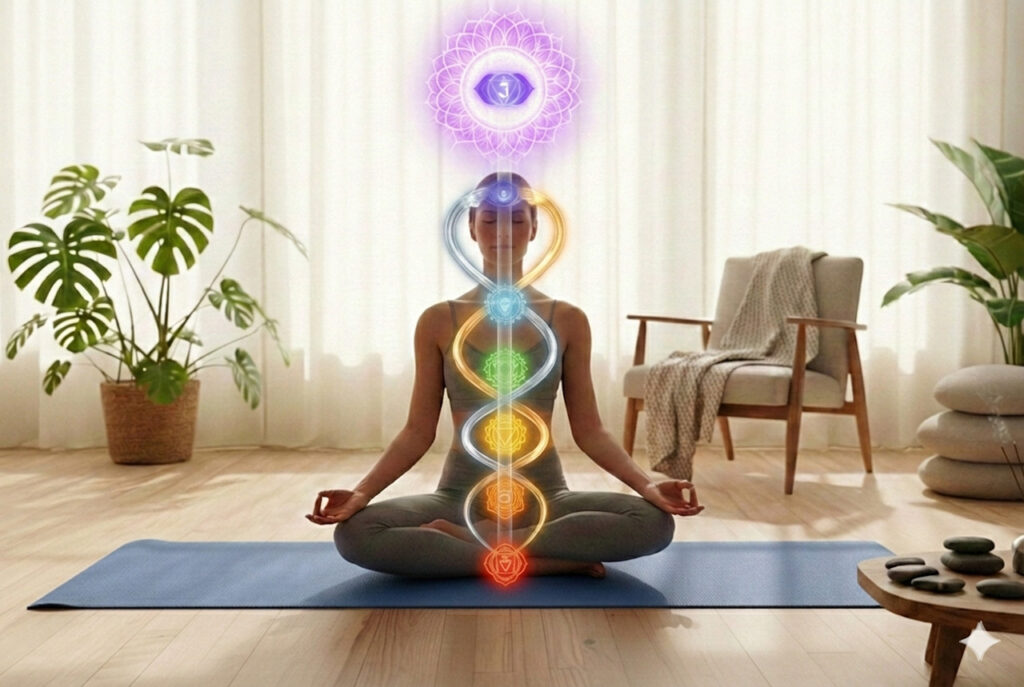
Under normal, unawakened conditions, life force energy (prana) is said to be split into dual, opposing currents or channels: ida (feminine, lunar, magnetic, receptive) and pingala (masculine, solar, electric, active). As long as consciousness is polarized or dominated by one current over the other, life force energy will zig zag back and forth through these two channels, keeping awareness anchored to physical space/time dualities.
But when the ida and pingala are balanced, then it’s said to create a metaphysical zero point or state of equilibrium (state of stillness). Could this be synonymous with the two forms of ether merging in David Wilcock’s (Researcher of Ancient Civilizations, 1973 – 2026) model and the middle pillar associated with the three pillars in the Kabbalah? But we digress… Once the ida and pingala achieve this energetic equilibrium, their dual currents are said to collapse into the central channel, sushumna. This neutralization is said to unlock or awaken kundalini energy — a unified, potent form of life force energy.
It’s thought that we can use spiritual and physical practices of yoga — like kundalini yoga and pranayama breathing — to harmonize the ida and pingala and awaken kundalini. Could this process be what Jesus was referring to when explaining that no man can come unto the Father but by him (The Bible: John, 14:5)? Perhaps “him”, referred to the middle way — a unified path where we balance our feminine and masculine polarities through refinement of the mind and body to achieve vibrational harmony with Source. Now that’s hard-hitting.
Meeting Point of Cosmic and Inner Energies
Once kundalini energy begins to rise toward the crown energy center, two things are said to happen thanks to the heart energy center. One is that we can resolve any distortions or blockages as the energy travels upward through the energy centers. Two is that we can project the energy outward through the nadis, contributing to what we consider to be our electromagnetic energy field (aura). How is this possible? This would be possible because the heart energy center is said to have a double spiraling nature. The first spiral propels kundalini to rise through the heart gateway while the second spiral takes this integrated kundalini and projects it outward through the nadis.
It’s also possible that rising kundalini can trigger another phenomenon which the Law of One (49:5-6) refers to as the meeting place of cosmic and inner energies or the true definition of kundalini. Based on our understanding, kundalini could be considered cosmic energy while intelligent infinity could be considered inner energy. Is this what’s referred to in Hinduism and Tantra as the union of Shakti and Shiva? Let’s elaborate on this.
The downward-moving inner energy described by the Law of One could be synonymous with divine grace, Shiva (divine masculine, unmanifested consciousness), and intelligent infinity (pure consciousness). And the upward-seeking cosmic energy could be synonymous with the seeking nature of kundalini, Shakti (divine feminine, creative life force), and the conversion of light/love to love/light. We consider light/love and love/light to be distinct polarities of intelligent energy much like feminine and masculine are considered distinct polarities of life force energy. The only difference being their ratio of light to love or masculine to feminine.
Based on our understanding, the ultimate goal of the seeker would then be to use their willpower to move the meeting point of these two cosmic and inner energies higher up the energy centers. As explained by the Law of One (49:5), the point where they meet would reflect our overall vibratory understanding and awareness level. As the Law of One (57:33) states, wherever these two spiraling lights meet, the realization of intelligent infinity takes place, serving as the signature of the soul’s readiness for its next level of experience.
It’s even suggested by the Law of One that there is also a physical manifestation of this meeting point process which is used to determine our next level of experience. It involves using our indigo ray body, and kundalini energy as fuel, to ascend steps of divine light or intelligent infinity. Essentially, we continue to ascend until we’re unable to handle the intensity of the light. This stopping point would determine our consciousness level and corresponding next level of experience. We refer to this process as the steps of light ascension process — which typically occurs after death or during a harvest (Law of One, 6:14).
Kundalini is considered a type of potent, life force energy as well as the process of unifying feminine and masculine polarities.
Kundalini Awakenings
What Are Kundalini Awakenings?
It’s said that awakening kundalini energy can act as a catalyst for spiritual evolution. Yogic teachings explain that awakening kundalini energy can cause a powerful energy surge that can propel us further along our spiritual paths toward different levels of samadhi. Samadhi refers to deep, blissful superconscious states, with the ultimate state as oneness of self and Source (Bhagavad Gita, 6:31 & Autobiography of a Yogi, 12:94). Sadhguru (Guru, Yogi & Mystic) refers to samadhi as equanimous intellect. There are generally three distinctions of samadhi.
- Sabikalpa samadhi (with difference) is considered a temporary state where consciousness is fully absorbed and life force energy is withdrawn from the body, like in suspended animation. Yet, a subtle trace of identification or thought (seed) remains because we’re still under the influence of maya (Autobiography of a Yogi, 26:209-210).
- Nirbikalpa samadhi (without difference) is considered the highest state of absorption where all traces of thought, duality, and ego are completely transcended or harmoniously purified. It’s achieving liberation while still retaining a material body.
- Mahasamadhi (great samadhi) is the conscious, voluntary, and final exit from the physical gross body by a liberated soul. It’s achieved while in the state of nirbikalpa samadhi.
What Do We Feel When Kundalini Awakens?
Kundalini awakenings have been said to trigger a multitude of actions and feelings. This is because energy is surging up our spine. Many agree that this surge is essentially clearing energy blockages, upgrading our nervous systems, and upgrading our capacity to hold more light and sustain a higher frequency. Because of this, some experience involuntary movements, heightened senses, intense mood shifts, sleep changes, expanded consciousness, increased knowledge, accelerated healing, unlocked gifts, released trauma and habits, and direct connection to Source (God-realization), to name a few. While others may experience very little.
Can trauma be associated with a kundalini awakening? Our research suggests kundalini energy can be awakened by trauma or stress. But the most common method to trigger a kundalini awakening seems to be through yogic practices such as meditation, asanas, breathwork (pranayama), and chanting mantras, to name a few. Some caution that kundalini awakenings can be dangerous, overwhelming, and disruptive if not initiated consciously, especially if we have energy blockages. Others suggest that kundalini awakenings will only happen when we’re ready.