



What Is the Source of Creation?
The Divine Essence of Everything
The Silence From Which Creation Emerges
The mainstream scientific community still leans toward the notion that there isn’t a source of creation. But, we simply can’t deny there are many resources that seem to refer to the same infinitely eternal, omnisciently omnipresent source that underlies all of creation (The Kybalion, C:4). In Christianity, the source of creation is considered God, although Gnostic traditions refer to it as Monad. In Hinduism and Vedanta, it’s referred to as Brahman or Parama Brahman. In Taoism, it’s considered Tao. In Islam, it’s considered Allah. In The Kybalion, it’s referred to as THE ALL. In the Law of One, it’s referred to as infinity. And the list goes on! Are all of these different names simply semantics?
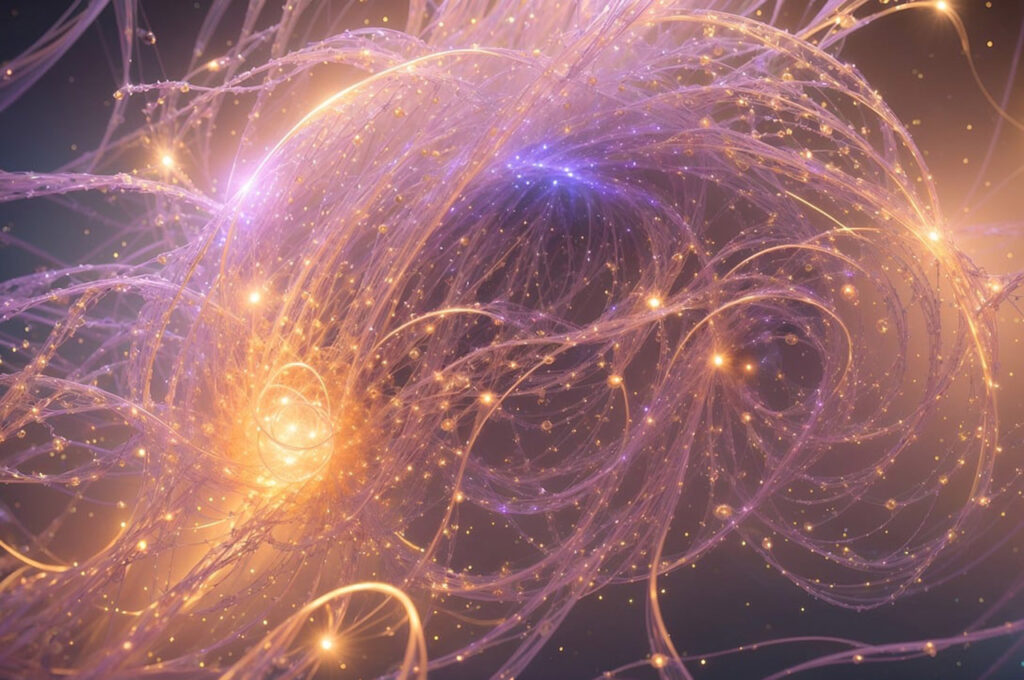
Fellow souls, we understand that our pesky minds and egos can’t fully convey or understand the source of creation without a bit of help. But, if one did try to define it in words, what would those words be? Well, let’s first try to wrap our minds around a fundamental concept. That concept is that perhaps everything in creation emerges from one eternal void, energy of empty space, or source field that we refer to as Source (The Godhead). This void in esoteric terms is considered non-duality, unity, undivided awareness, and the silence before emanation and manifestation.
This concept suggests that everything is manifested from this silence, including the creative force that wills creation and consciousness into existence. Essentially, as layers of reality emerge, structures form, and consciousness begins to separate. As dramatized through many religious and spiritual traditions, the real kicker is when awareness begins to identify with those forms (ego), structure becomes identity, identity becomes inherited perception, and inherited perception becomes filtered interpretation and fragmented reality. This is where ignorance (misidentification) and misunderstanding begins.
Let’s ponder that for a second…
Infinite Attributes of Source
As we venture down this rabbit hole of Source, we must also wrap our minds around the concept that Source possesses infinite divine attributes (qualities) and roles, according to the Bhagavad Gita (14:26). Yet, several of our resources — including Swami Mukundananda (Bhakti Yog Saint & Yoga Teacher) and The Kybalion (C4:57) — also explain that Source is beyond material attributes such as ego, jealously, fear, anger and all the lower-vibrational attributes we succumb to in the material universe. This distinction is considered a cornerstone of our research.
So what are some of the divine attributes of Source? Swami Tathagatananda (Monk & Spiritual Leader, 1923 – 2016) specifically mentions that Brahman is characterized by sat-chit-ananda. Sat represents self-existence, eternality, or absolute reality. Chit represents self-awareness or pure consciousness. And ananda represents intrinsic bliss.
The Bhagavad Gita (8:9-10) mentions at least eight divine characteristics of Source:
- Omniscient – Knowing past, present, and future
- Eternal – Without beginning or end
- Controller – Everything is under Source’s domain
- Metaphysical – Exists in subtle form
- Sustaining – Origin of sustenance
- Divine – Exists in forms only conceivable through Source’s grace
- Luminous – Brighter than the sun
- Transcendent – Beyond darkness and ignorance
The Bhagavad Gita also mentions other characteristics, such as Source is equally disposed to all living beings and is neither inimical nor partial to anyone (9:29). While all of the divine attributes mentioned do not come close to fully encompassing Source, they have provided us with a general starting point for our seeking.
Oneness: Everything Derives From Source
Interconnectedness concepts are common in the Law of One’s cosmology where it explains that everything is manifested from infinity and the One Infinite Creator (13:5-15). Fellow souls, if everything is part of Source’s creation, then this suggests that we’re all naturally connected to Source, like drops in the same ocean. Ergo, All is One (Law of One, 4:20), The ALL is in All (The Kybalion, C7:96), and infinity is unity (Law of One, 1:7).
While the mainstream scientific community is divided on the concept of oneness, oneness is a constant fixture throughout our research. We have to admit that some religions and spiritual masters teach the concept of oneness more openly than others depending on circumstances and cultures. An example being Sri Krishna’s candid, detailed teachings versus Jesus’s vague parables (The Bible: Matthew, 13:10-15). Although, it’s said that Jesus was able to speak more candidly to the disciples who were ready to hear or who were able to see clearly through the illusion, as suggested in buried books like The Apocryphon of John.
The oneness concept is also consistent with energy-based philosophies like illuminationism, panpsychism, and panspiritism. Panpsychism suggests that all basic particles of matter have consciousness. Panspiritism suggests that a fundamental quality is inherent in everything, but everything doesn’t have individualized consciousness. The Islamic illuminationism philosophy suggests that light is the fundamental reality of existence, which is expressed in degrees of intensity.
Interconnectedness Concepts
Quantum Entanglement
When it comes to interconnectedness, we won’t dive into quantum mechanics or other scientific areas of study. But, concepts like quantum entanglement, resonance, fractals, nonlocality, and branching are already realized concepts for advanced extraterrestrial (ET) civilizations. Quantum entanglement, at the very least, would have to be realized in order to account for interstellar travel, right? It also seems to be a realized concept for those within covert scientific communities here on Earth using, what Dr. Steven Greer (Founder of The Disclosure Project) likes to call, reverse-engineered advanced technology (AT) and extraterrestrial vehicles (ETVs). But we digress…
Now, it seems that these types of interconnectivity and nonlocality concepts are slowly gaining more and more interest in the mainstream scientific community, specifically relating to morphic resonance (collective memory) and as tech evolves into quantum computing. For example, researchers have leveraged quantum entanglement to demonstrate quantum teleportation over fiber-optic cables. We didn’t mention it before, but quantum entanglement is considered a spooky link between two particles that share a single state no matter how far apart they are.
Evidence of Interconnectedness
Some of the earliest and most thought-provoking evidence of our interconnectedness was discovered by Jagadish Chandra Bose (Physicist & Plant Physiologist, 1858 – 1937) through his creation and use of a crescograph. Luther Burbank (Botanist & Horticulturist, 1849 – 1926) even conducted experiments to create spineless cacti simply by talking to the plants to create a vibration of love and safety, according to Autobiography of a Yogi (38:308). Other evidence can be found in the Secret Life of Plants and with the Backster Effect. As mentioned in the Law of One (81:33), that which is learned by one is known to all.
Evidence suggests that plants, bacteria, yogurt, planaria worms, and human cells are attuned and affected by the vibrations within their environment. Does this mean that plants and other entities are conscious, as mentioned by Swami Mukundananda (Bhakti Yog Saint & Yoga Teacher) (Bhagavad Gita, 13:27)? Even Maharishi Effect studies have scientifically proven that transcendental meditators can impact behavior in nearby locations. The Maharishi Effect further demonstrates the concept of nonlocality — two events can be connected even when they’re separated by vast distances.
These examples of interconnectivity and nonlocality suggest that there are parallels between the microcosm and macrocosm of the material universe. These parallels would be consistent with the principle of correspondence in Hermetic philosophy which states, as above, so below; as below, so above (The Kybalion: C2:28, C8). Don’t take our word for it. Evidence of our interconnectedness is all around us if we remain open-minded enough to seek it.
Happy seeking fellow souls!