



What Is the Holy Trinity?
The Holy Trinity Explained
When we refer to Source, we are referring to the one unified, infinitely eternal source of all there is — the creator, sustainer, and transformer of everything. The Godhead. Meaning, Source is not limited to a single manifestation, form, or expansion (Bhagavad Gita, 4:7). We resonate with the concept that All Is One (Law of One, 4:20). And that ONE can possess innumerable attributes and forms because of the fundamental principle of unity in diversity. Fellow souls, would this be considered a monotheistic point of view?
Monotheism emphasizes Source’s absolute transcendence, unity, and incorporeality (being without a physical body or shape) — ergo, the belief that there is only one God whom all power ultimately resides. Christianity, Judaism, and Islam, to name a few, seem to resonate with variations of monotheism. We say variations because it’s difficult to neatly classify Christianity, for example, as monotheistic when God is referred to in the context of a trinity. Regardless of how one defines Source, concepts like the trinity and monotheism are intriguing. So let’s dive further into the rabbit hole.
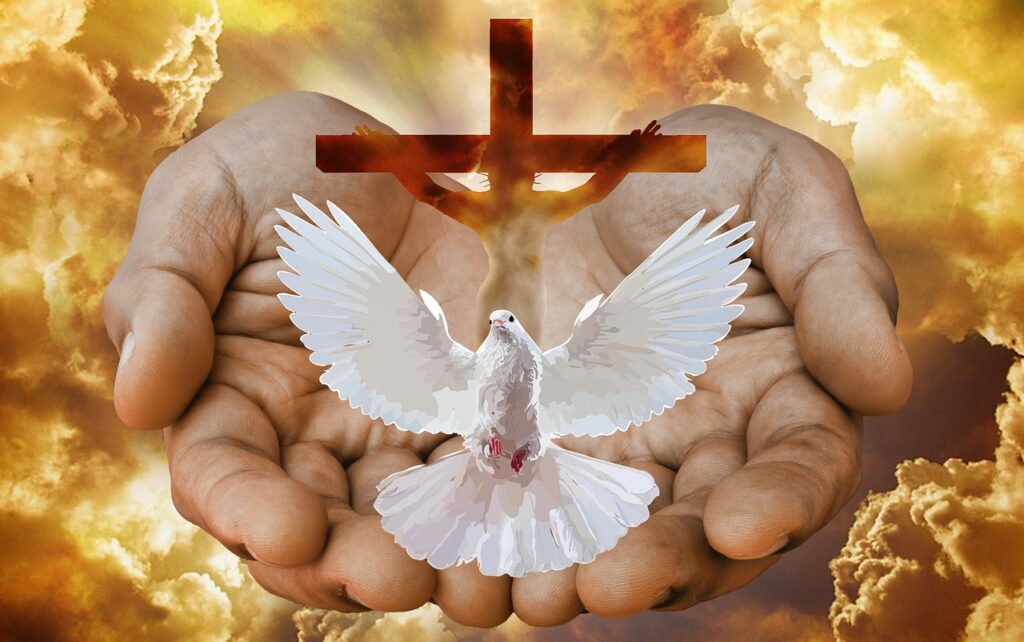
It’s no secret that many religions refer to Source in the context of a holy trinity (Edgar Cayce Reading, 5749-3). And yes, it can be confusing. What exactly is the holy trinity? The most common definitions of the holy trinity is that there is one Godhead that exists as three distinct, co-equal, and co-eternal entities. Or there are three distinct entities that exist in one Godhead. Whether or not the holy trinity represents states of being versus tangible entities with their own essence is debatable. What’s less debatable is that the holy trinity concept seems to have a framework that includes a formless, impersonal absolute; divine personal architect with form; and a divine, indwelling presence.
The Trinity Summarized
ROLE
LAW OF ONE
VEDIC
BIBLICAL
FUNCTION
The Absolute
Source
Infinity
Parama Brahman
(Beyond Attributes)
The Godhead (God)
The Void (Non-Duality, Unity), Silence From Which Creation Emerges
The Power
Source
Intelligent Infinity
(Infinity + Will,
One Infinite Creator)
Divine Light
(Brahman, Bhagavan)
The Father (The Word,
God)
Awareness (Pure Consciousness), The Moment Infinity Decides to Realize Itself, Sovereign Entity That Wills Creation
The Architects
Logoi (Infinite Love,
Creative Principle)
Intellect (Buddhi),
Sri Krishna (Seed-Giver), Brahma
The Son (Jesus Christ)
Creative Intelligence, Focuses Awareness into Stepped Down Geometric Vibrations and Blueprints
The Medium
Intelligent Energy, Ether
(Love/Light, Light/Love)
Prakriti
(Para Prakriti, Apara Prakriti)
The Holy Ghost
(Holy Spirit, Breath of Life, Barbelo, Mother)
Medium With Active Material (Clay), Essence Filling Universe and Animating Forms
The Way
(Bridge)
Indigo Ray Activation (Opening Gateway
to Intelligent Infinity)
Unity, Oneness, High
Vibrational Frequency)
Return Path, Disciplined Process Used to Purify Matter and Dissolve the Illusion of Separateness from Source
Intelligent Infinity, Logoi, Light
The Law of One refers to the trinity in the context of creation (13:5-15) as intelligent infinity (One Infinite Creator), logoi (creative principle), and intelligent energy (universal light). Intelligent infinity is considered pure consciousness (infinity + will). It’s the point where infinity (nothingness, stillness, silence, void, total potential) becomes active and prepares to will the universe into existence (13:5-15).
Logoi (logos singular) are seen as the creative principle and architects manifested by intelligent infinity. The underlying nature of logoi is said to be love. Love is considered the inward-flowing, passive, receptive, attracting, nurturing aspect that receives information and influence from creation. Each logos uses its will and love to create and organize intelligent energy.
Intelligent energy is considered the raw, etheric medium through which active material or universal light is organized and shaped, like clay. This etheric medium essentially polarizes into a dynamic, binary system of universal light. Universal light (photons, particles) (41:9) is considered the building block of all existence. It exists on a spectrum, based on the ratio of love to light — love/light and light/love. Ergo, love/light is considered the raw material, logoi are the creative intelligence that shapes this material, and light/love is considered the physical manifestation that results from that creative process.
Brahman, Bhagavan, and Paramatma
The Bhagavad Gita refers to the trinity as three distinct concepts, levels of realization, or manifestations of Source: Bhagavan (the source of divine light), Brahman (the divine light), and Paramatma (the divine light within living entities).
It refers to Bhagavan as the complete, divine personal form and supreme divine personality (12:1). Bhagavan is portrayed as the form that eternally resides in the spiritual universe engaging in divine pastimes (leelas). It’s seen as the origin of everything: the divine light of Brahman (7:24), all energies, avatars, and expansions, including souls. Bhagavan is said to possess all six opulences (beauty, wealth, strength, fame, knowledge, and renunciation) simultaneously and completely. The personal form is said to allow for a more loving and devout relationship with Source, making full-God realization attainable (Bhagavad Gita, 18:55). The Bhagavad Gita (10:8) mentions that Sri Krishna is considered the Bhagavan.
The Bhagavad Gita portrays Brahman as the formless, impersonal aspect of Source, representing absolute truth and realty (12:3-4). It’s the divine light emanating from Bhagavan (7:24), portrayed as pure consciousness and the eternal spiritual essence that pervades existence. It’s considered omniscient, eternal, omnipresent, unmanifested potential, and imperishable. The sacred syllable Aum (Bhagavad Gita, 7:8) is thought to be a symbolic expression of Brahman and the primordial sound that pervades creation.
The Bhagavad Gita (8:4, 13:23-28) portrays Paramatma as a partial, localized expansion of Bhagavan — supervising the material universe and continuously anchoring the spiritual reality within it. Could Paramatma be synonymous with Sophia (divine feminine principle, Gaia) in Gnostic traditions? While not considered an avatar, Paramatma is thought of as an infinite, omniscient, plenary portion or expansion of Bhagavan (it isn’t born or dies), but not a complete manifestation. It’s considered the supreme soul and supersoul often associated with Lord Vishnu. Paramatma is not considered the soul, but is what allows the soul to remain conscious and experience the reactions of its material desires.
As the knower of all fields (ksetrajna), Paramatma is said to accompany souls throughout incarnations, acting as a silent witness and permitter for their actions while in the material universe. It’s considered the divine light of Brahman that has stepped down as spiritual energy to reside in the heart of every living entity (Bhagavad Gita, 15:15) and pervade every atom in the material universe. Paramatma is said to note our actions, sustain all individualized consciousness, keep track of karma, and deliver karmic results at an appropriate time (Bhagavad Gita, 13:23). While Paramatma resides within the material universe, it’s considered completely spiritual and remains untouched by material energy and the illusionary force of maya (13:32).
Father, Son, and Holy Ghost
The Bible (Matthew: 28:19) refers to the holy trinity as the Father, Son, and Holy Ghost. However, there are varying interpretations for each of those terms.
The Bible portrays God, the Father, as the source of all things (John, 1:3) and the one who judges no man but commits all judgment to the Son (John, 5:22). It portrays the Son as the Word made flesh, Jesus Christ, agent of creation, willpower, and the only begotten of the Father (John, 1:14-17). Gnostic teachings suggest that Christ was conceived from the Father and Mother. The Mother would be considered Barbelo — the first thought of the Father, androgynous womb of everything (The Apocryphon of John) and, to some, the Holy Ghost. The Bible portrays the Holy Ghost as the breath of life and comforter (John, 14:26). It can praise, inspire, guide, and empower us to make choices that align with God’s will (The Bible: Luke, 3:22).
Autobiography of a Yogi (14:128), on the other hand, portrays the Father as the absolute and unmanifested, existing beyond vibratory creation. The Son is considered Christ Consciousness, the only begotten or sole reflection of the uncreated infinite, and that which exists within vibratory creation. It further suggests that the outward manifestation or witness of Christ Consciousness is the sacred syllable Aum or the Holy Ghost. Aum is considered the comforter and the divine power that structures creation through vibration.
Edgar Cayce (Clairvoyant & Healer, 1877-1945) has a similar interpretation but makes a distinction between Jesus Consciousness and Christ Consciousness. Edgar explained that Christ Consciousness is the universal consciousness of the Father Spirit. It’s the approach of being one in spirit with the Father, reached only by abandoning carnal forces (Readings: 262-29, 5749-4). It’s further described as the awareness within each soul, imprinted as a pattern on the mind and waiting to be awakened by will (Readings, 5749-14).
Sarah Elkhaldy (Spiritual Teacher & Energy Healer) explains that the Christ Consciousness level or state of awareness embodies an awakened heart energy center (love), unity consciousness, spiritual awakening, discernment (masculine expression of wisdom in action), dharma, and sovereignty. Ergo, she views Christ Consciousness as a specific attribute of the overall state of being referred to as ascended master consciousness. Ascended master consciousness is considered the ultimate state of perception where discernment and unconditional love coexist in unity. Sarah further explains that each ascended master highlights a specific attribute of this ultimate state of being — meaning there is Christ Consciousness, Buddha Consciousness, Isis Consciousness, and more.
Jesus consciousness, on the other hand, is considered turning the material body — through love, discipline, and devotion — into a sacred temple so that we’re able to reach the vibrational frequency and level of awareness that Jesus did (Christ Consciousness), enabling us to fully and purely express divine light through the material body (Edgar Cayce Readings, 5749-4). Could awakening Christ Consciousness explain why Jesus was bestowed with the distinction of Christ — signifying that we all have the potential to reach or awaken this level of awareness? This seems to be corroborated in The Bible when it explains that believers can also become children of God (Matthew: 5:9, 5:45).
What if reaching the Christ Consciousness awareness level is what Jesus eluded to as a second coming (The Bible: John, 14:3-6 & Edgar Cayce Reading, 5749-5)? Is it also possible that reaching the Christ Consciousness awareness level is what Jesus was referring to when he explained he is the way, the truth, and the life and that no man can come unto the Father but by him (The Bible: John, 14:5)?